

Steps.
Photographic series.
2008-2009.
The Steps project was initially conceived out of an interest in public space and its configuration within the marginal neighborhoods of the city of Medellín. The work articulates two basic concepts that characterize a large part of the inhabitants of these neighborhoods: the appropriation of territory and the construction of the notion of place.
This dynamic gives rise to structures that primarily solve practical problems such as access or shelter, but which simultaneously consolidate themselves as symbolic elements that reflect the inhabitants' ideals, their notion of progress, and ultimately, the place from which they can foresee a future.
This project consists of:
- Photographic series: Steps.
- Installation: Spine.
- Sculptures: Progression.
Horizontal Position.
Bifurcación. Impresión inkjet. 108 x 163 cm. 2008.
Noel. Impresión inkjet. 163 x 108 cm. 2008.
Morada. Impresión inkjet.163 x 108 cm. 2008.
Muralla. Impresión inkjet. 108 x 163 cm. 2008.
Nexo. Impresión inkjet. 163 x 108 cm. 2008.
Lugar propio. Impresión inkjet.163 x 108 cm. 2008.
Sin título. Impresión inkjet. 108 x 163 cm. 2008.
Sin título. Impresión inkjet. 163 x 108 cm. 2009.
Tumba. Impresión inkjet. 163 x 108 cm. 2008.
Tránsitos. Impresión inkjet. 108 x 163 cm. 2008.
Horizontes. Impresión inkjet. 108 x 163 cm. 2008.
Itinerarios 1. Impresión inkjet. 108 x 163 cm. 2008.
Itinerarios 2. Impresión inkjet. 163 x 108 cm. 2008.
Estructura. Impresión inkjet. 163 x 108 cm. 2009.
Astas. Impresión inkjet. 163 x 108 cm. 2009.
Nave central. Impresión inkjet.108 x 163 cm. 2008.
Itinerarios 3. Impresión inkjet. 108 x 163 cm. 2008.
Puente. Impresión inkjet. 108 x 163 cm. 2009.

Spine
Installation
1100 x 800 x 1400 cm.
2009 - 2010.
Spine emerges from the experience of walking through the marginal neighborhoods of Medellín and from the analysis of documentation concerning the access routes that shape their public space. In this context, the main stairways and the smaller staircases built by residents to reach their homes are essential. The work Spine focuses on the articulation of these two constructive schemes and on how their convergence reflects a conception of public space that simultaneously responds to both individual and collective needs.
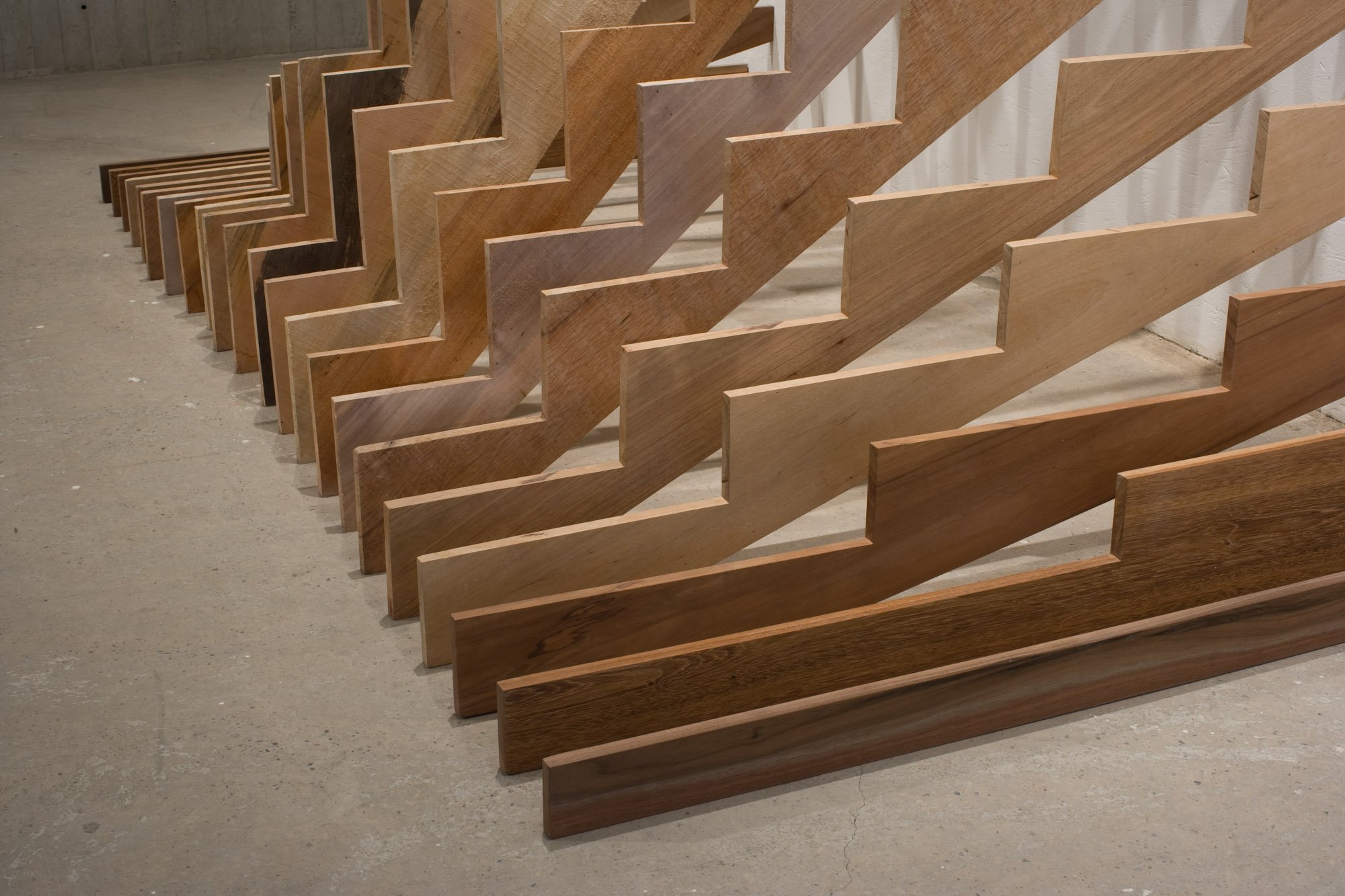
Progression.
Wood sculpture
330 x 180 x 280 cm.
2011.
Progression makes a comparative analysis of the inclination and materiality of staircases belonging to different socioeconomic levels to reflect the accessibility challenges to space in each of them. Through the use of planks placed in pairs in the space, the work reflects the conditions of the terrain and alludes to a social pyramid with marked contrasts in its architectural spaces. For this reason, each pair varies in height and is made of different qualities of wood: as the boards increase in step numbers and reach greater heights, their material becomes ordinary, gradually abandoning the fine and delicate treatment in favor of a direct materiality devoid of refinement.
Thus, at the external limits of Progression, the boards are only 8 cm high and their wood is sanded and polished, while those in the center of the piece are rough and reach a height of 330 cm.
The work also presents a metaphor for social advancement. A projection of an imaginary progress that depends and relies primarily on the physical capacity of the body and its effort.
Extended version


Horizontal Position
Installation
110 x 408 x 260 cm.
2011-2012.
Horizontal Position explores the dimensions and material qualities of “the bed” and its spatiality through a comparative strategy that highlights the stark material, economic, and social contrasts in the conception and construction of private space.
The project is an assemblage made from fragments of beds within a space that, due to its scale, resembles a room. Through the difference in size and material, an intersection is created between objects and private spaces that normally remain separate.